
The Tools We Reach For
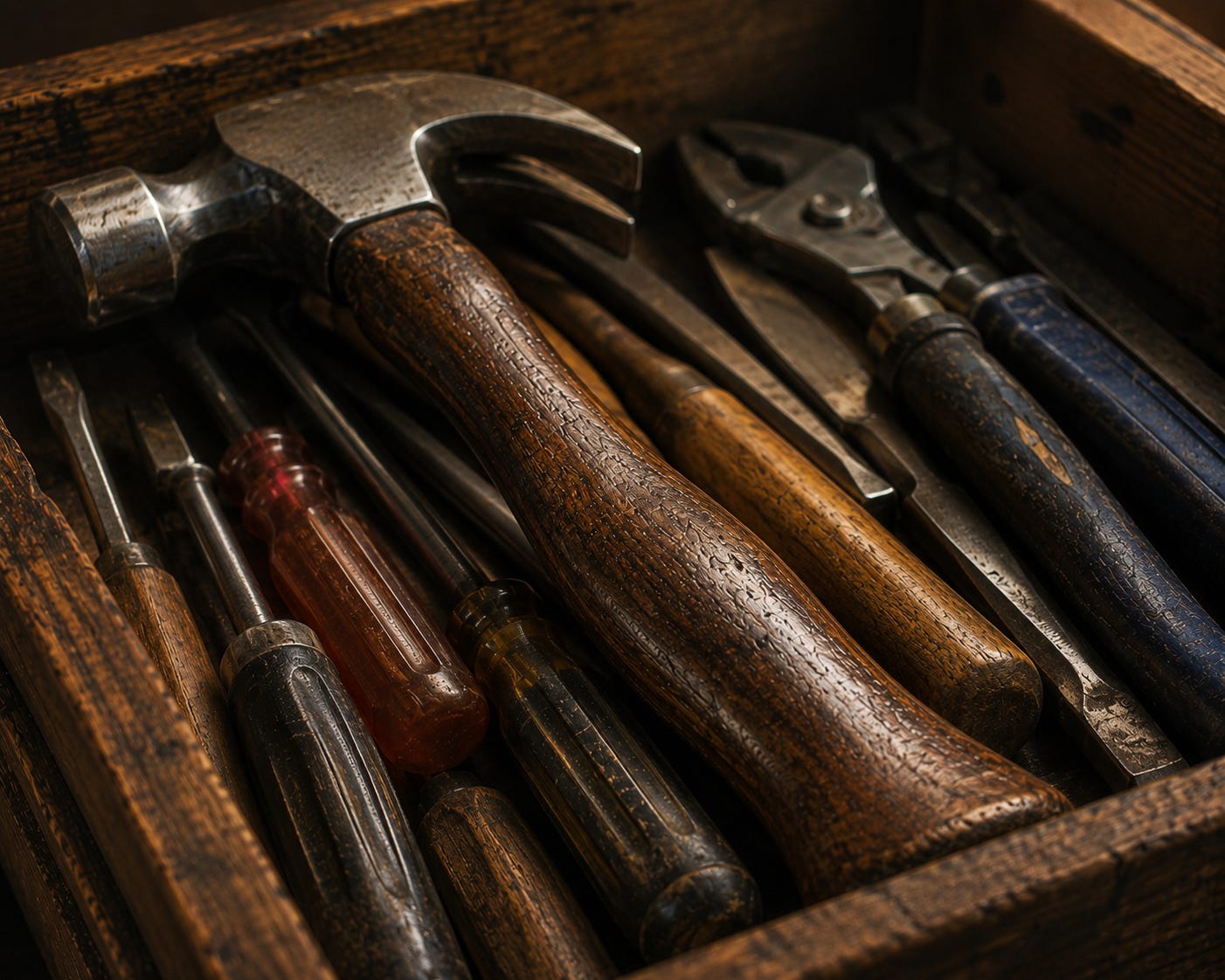
The Worn Handle

Whenever I begin working on an essay, I usually ask myself one question.
Why am I writing this one?
This week’s answer is easy. Because someone new to the game literally just asked me,
“What even is a toolbox? What are tools?”
Recovery people say it all the time.
“Use your tools.”
Got it.
But what exactly does that mean?
What does it look like at 10:47 on a Thursday night when your heart is broken and your keys are already in your hand?
This essay is my attempt to answer that question.
Not theoretically.
Practically.
What does using tools actually look like… in the wild?
Every once in a while I dump my toolbox out on the floor. Not the one in my garage. The one between my ears.
Prayer.
The pause.
Journaling.
Walking.
Phone numbers.
Recovery meetings.
Breathing.
Tai Chi.
Music.
Books.
Art supplies.
Robin.
Hope.
Gratitude.
That’s what my toolbox looks like today. But it didn’t always. Let’s rewind a few years. Let’s dump out ten-weeks-sober Shane’s toolbox.
Prayer. Sometimes.
A couple of phone numbers I’d collected but never called.
A journal with three pages written in it.
A breathing exercise I couldn’t quite remember.
Hope.
Lots and lots of hope.
...
Wait.
Alcohol?
How’d that get in there? I’ve been sober ten weeks.
That question haunted me.
How could the very thing I was trying to quit—the thing I hadn’t touched in nearly three months—still be sitting in my toolbox?
The answer took me a while to understand. Because sobriety and removal aren’t always the same thing. Sure, I wasn’t drinking anymore. But I was still thinking about it. Still talking about it. Still imagining it.
That’s understandable. That’s human.
But maybe there was still beer in the garage refrigerator. Maybe there was still tequila above the microwave. Or behind the hamper. You know… just in case. Maybe my drinking buddies still assumed I’d be there Friday night. Maybe, deep down, I hadn’t actually removed alcohol from the toolbox.
I’d just stopped reaching for it.
As long as it was still in there, it was still an option. Maybe not one I wanted. Maybe not one I’d publicly admit to wanting. But an option nonetheless.
And when panic takes over, my hand isn’t looking for the best tool. It’s looking for the most familiar one.
That was one of the first things recovery taught me. The goal wasn’t simply to stop swinging the hammer. It was to remove it from the toolbox altogether.
Then another realization came:
Everything I’d ever reached for was in there.
Alcohol.
Sarcasm.
Withdrawal.
Isolation.
Shopping.
Food.
Doomscrolling.
Anger.
Self-pity.
They were all tools. Some built things. Most destroyed things. But every one of them had solved something for me at one point or another.
Recovery wasn’t about getting a toolbox. I’d always had one. Recovery was about replacing what was inside it. Because life rarely gives you time to organize your tools. When you’re backed into a corner...
You don’t calmly kneel down and arrange your sockets by size.
You panic.
You reach.
And your hand almost always finds the handle that’s been worn smooth from years of use.
Example 1:
You’re in the middle of grief.
Not sadness.
Grief.
And the latest grief is always the worst grief. You’ve been collecting phone numbers for months. People keep telling you, “Call somebody.” You always nod. You never call. The grief has become unbearable.
All you can think about is escape.
All you can think about is drinking.
You’ve parked at the liquor store more than once this week.
Maybe even walked inside.
You’re crying. You unlock your phone. Not because you know what to do. Because you don’t. You scroll. Robotically. Past names you’ve seen a hundred times. Then…
A sober friend.
Someone you’ve thought about calling before. Never have. Your thumb hovers over the call button. Everything inside you says, “Don’t bother him.”
Instead—your thumb snaps down like a trip hammer.
Some part of you took over and did the thing all of you could not do. Too many scared parts to make that call. But the one part… It knew. It took over. It hit the button.
This is what using a tool looks like.
Not confidence.
Obedience.
Example 2:
You’re driving to Walmart. Not because you need groceries. Because you’re hurting. Sugar has quietly become the newest tool in your toolbox. You can already taste it. Twenty minutes until they close. You’re white-knuckling the steering wheel. The parking lot is just up ahead. Then…
The board meeting starts.
Current Shane makes his case.
Tomorrow Shane makes his.
Everybody gets a vote.
Half a mile from the entrance…
…you turn around.
Nobody outside of your head applauds. Nobody outside of your head even knows. You simply drive home.
This is what using a tool looks like.
Not perfection.
Governance.
Example 3:
You know the argument is coming. Or maybe it’s already here. Every sentence forming in your mind is sharper than the last. Then…
You stop.
You close your mouth. Then your eyes. Then your hands.
You breathe. You walk away.
Not forever. Just for now.
You write.
You pray.
You call someone.
You let the internal meeting happen before the words happen.
Hours later… You return. Same issue. Different perspective. Different man.
This is what using a tool looks like.
Not weakness.
Strength under restraint.
Example 4:
Depression is different. Sometimes it doesn’t take away your tools. It takes away your ability to remember you have them. Everything feels fifty pounds heavier.
The shower.
The dishes.
Walking.
Prayer.
Returning a text.
Everything.
But you’ve got responsibilities. You’ve got people who depend on you. You’ve got parents and pets and plants and property—all needing your attention. And somewhere, deep down inside you, there’s a part of you who remembers that during your drinking days—when depression hit—things in your care died or grew untamed. Not just plants and grass and weeds and bushes.
But relationships,
and responsibilities,
and jobs,
and self-love.
So you stop trying to use twenty-seven tools. You pick one.
Brush your teeth.
Walk to the mailbox.
Play one song.
Read one paragraph.
Text one friend.
This is what using a tool looks like.
Not conquering depression.
Refusing to surrender to it.
Example 5:
You miss your Prosecco. Not alcohol.
Specifically...
Prosecco.
On the deck.
You almost give in this weekend. You actually hear yourself say, “Eff it. I’ll just reset my time.”
For a moment… It sounds perfectly reasonable.
Then something interrupts the hijacked meeting. You play the tape forward. Not just to the first sip. All the way to the part where you ruin everyone’s night. So you get up. Walk into another room. Drop and do five and a half pushups on the way. Pick up your journal. You sit down in a huff and write until the craving loosens its grip. Then you get on a meeting. You tell the truth before addiction gets to tell its version. You call yourself out.
A few days later, you’re sharing again. Not because you relapsed. Because you didn’t.
You made it through another weekend sober.
This is what using tools looks like.
Not one giant tool. Several small ones.
Playing the tape forward.
Changing rooms.
Writing.
Sharing.
One ordinary decision after another.
Here’s what I’ve learned.
Tools don’t magically appear the day you need them. You collect them. You practice with them. You wear them into your hands.
Because when life backs you into a corner…
…you don’t suddenly become wise.
You reach.
Your fingers brush across unfamiliar handles.
All the new stuff piled on top.
Prayer. Too unfamiliar.
Journaling. Too awkward.
Breathing. Not today.
You rifle past a few more.
Calling a friend.
Walking.
Getting on a meeting.
Nope. Nope. Nope.
Then…
Your fingers wrap around that old worn handle. Smooth. Comfortable. Perfectly shaped to your hand.
That’s addiction.
That’s muscle memory.
That’s habit.
That’s also a pattern that can evolve into something good.
Recovery is teaching my hand to reach for different handles first.
Maybe that’s all a toolbox really is. Not a collection of perfect answers. Just a growing collection of healthier things to reach for before life convinces you to grab the old ones again.
Because eventually…
The pause becomes the worn handle.
The phone call becomes the worn handle.
Knowledge that this too shall pass becomes the worn handle.
Prayer becomes the worn handle.
Walking becomes the worn handle.
Hope becomes the worn handle.
And one day—without even thinking—your hand reaches for something that builds instead of destroys.
Thanks Shane, great use of analogies once again, love the worn handle image.
Don’t forget steps! And helping a newcomer, the best reminder that we don’t want to go back to where they are.