
The Whole Room
Reassembling the Crew

I should probably start with the fact that I’m writing this in the middle of a depressive stretch.
Not the dramatic, life-on-fire kind.
Just the heavy kind. Like someone quietly cranked up Earth’s gravity by twenty percent.
Foggy and drizzly with a distant source of light I can’t quite make out. The kind of depression where the rain and the dark both seem like your friend. The kind where everything feels slightly farther away than it should.
Slower than it should.
Sadder than it should.
I’ve gone to therapy.
Talked things through with people I trust.
Prayed.
Walked.
Slept a ton.
Worked out.
Written.
Sat quietly with God.
Done the healthy things.
And for now, apparently, I’m still sitting in it.
But maybe that’s exactly why this feels important to write. Because a few years ago, depression would have become the narrator of my entire life.
Now it’s just one voice in the room.
A loud one sometimes.
A persuasive one.
A convincing one.
But not the only one.
And most importantly—not the driver.
That realization has changed my understanding of recovery more than almost anything else.
I used to think addiction was mainly about substances.
Alcohol.
Escapism.
Compulsion.
The obvious stuff.
Now I think addiction is often the progressive fragmentation of the self long before the substance ever enters the story.
Alcohol didn’t destroy my life all at once.
It seeped into cracks that were already present, and it dismantled things slowly.
Moment by moment.
Lie by lie.
Compromise by compromise.
Avoidance by avoidance.
Likewise, I didn’t lose myself all at once either.
I lost parts of myself gradually.
The curious part.
The peaceful part.
The playful part.
The honest part.
The hopeful part.
The disciplined part.
The grounded part.
Some got silenced.
Some got numbed.
Some got buried under survival.
Some just stopped believing they mattered anymore.
And what’s strange is that once I finally removed alcohol from my life, I realized many of those parts had already begun disappearing years before I ever took my first drink.
They weren’t simply standing around in the smoke and debris waiting on a triage doctor. Some of them had been missing for years.
I started to see that alcohol wasn’t always the cause. Sometimes it was the anesthetic.
And that changes how I think about recovery now.
Because for me, recovery is not merely quitting substances.
It’s the gradual process of becoming internally whole enough that fewer and fewer parts of me need to be silenced, sedated, distracted, or abandoned just so I can survive the day.
That process has been slower and stranger than I expected.
I thought healing would feel triumphant.
Honestly, a lot of it has felt more like quietly walking through the aftermath of a tornado looking for survivors.
“Oh wow... there you are.”
The creative part.
The childlike part.
The part that still loves music.
The part that still loves to tell dumb dad jokes.
The part that likes exercise.
The part that wants to help people.
The part that still believes tomorrow is worth caring about.
And maybe the strangest realization of all is this:
Recovery hasn’t felt like becoming somebody new.
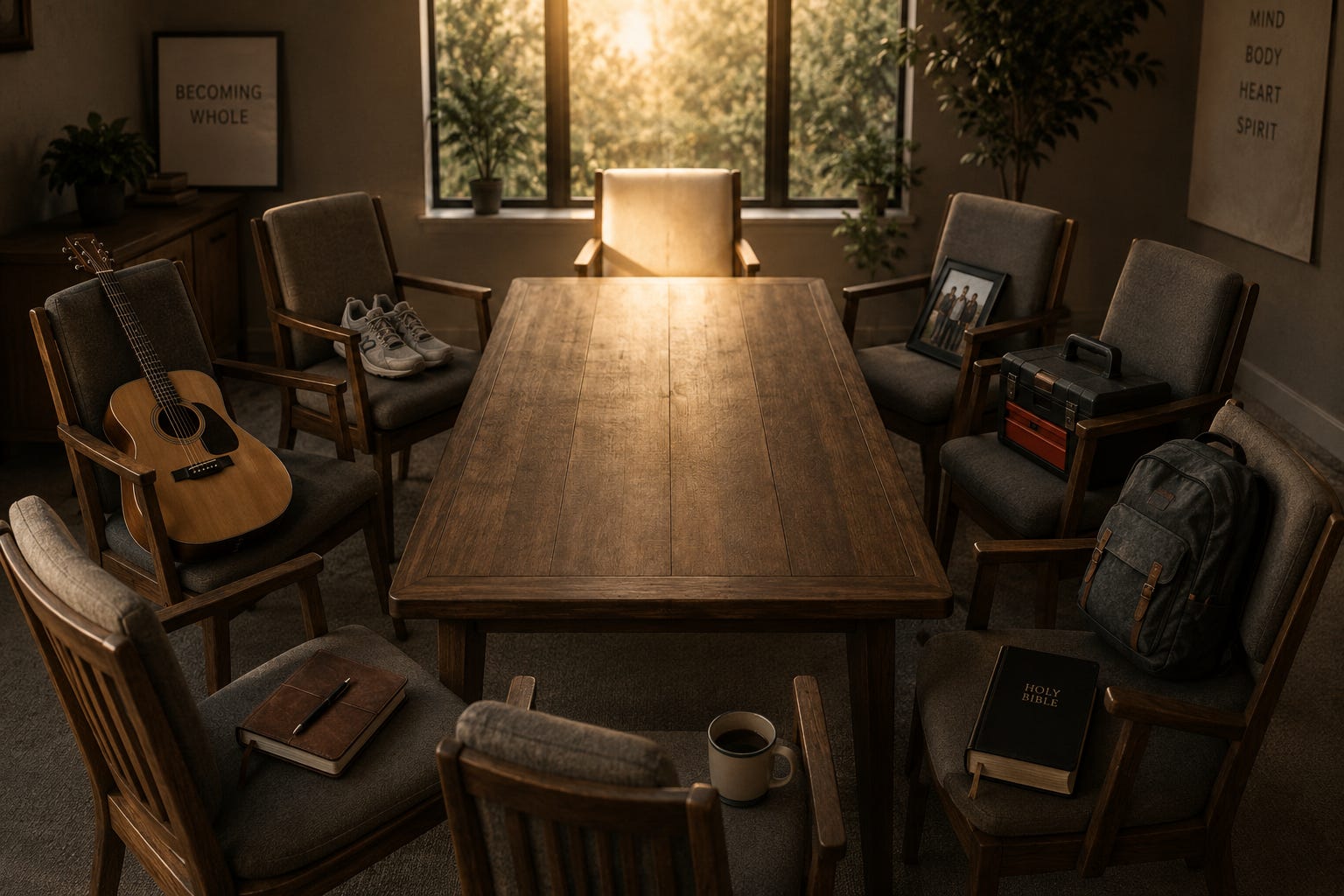
It has felt like reassembling the crew.
I picture it sometimes like a morning roll call inside myself.
Tomorrow Shane?
“Here.”
Fitness Shane?
“Present.”
Frugal Shane?
“Trying.”
Efficient Shane?
“Running late but here.”
Helper Shane?
“Always.”
Hurting Shane?
Quietly raises hand.
“Here.”
Higher Shane?
“Still learning. Still here.”
And Depression Shane?
Yeah.
Him too.
That’s the part I didn’t understand before. Healing is not kicking hurting parts of yourself out of the room. It’s learning not to give them absolute authority. That distinction matters enormously.
Because addiction often works like this:
One frightened, impulsive, exhausted, lonely, ashamed, pleasure-seeking, or hopeless part hijacks the entire system.
One part grabs the steering wheel while everybody else gets gagged and shoved into the trunk.
And for years, that was basically my internal operating system.
One emotional state became reality itself.
One craving became an emergency.
One fear became prophecy.
One silence became abandonment.
One disappointment became hopelessness.
Everything became total.
But recovery—real recovery—has slowly started teaching me something different.
The whole room gets a voice.
Not the whole room gets control.
That’s maturity.
That’s integration.
That’s peace, at least for me.
Not the absence of conflict internally.
Governance.
And governance means thinking beyond the moment.
It’s the difference between hearing every voice and obeying every voice.
These days, when I’m about to make a decision, I try to pause and ask a different question:
“Who will regret this tomorrow?”
Because I’ve noticed something.
The part of me making a decision and the part of me living with it are not always the same person.
Impulsive Shane buys the thing.
Tomorrow Shane pays the credit card bill.
Exhausted Shane skips the workout.
Tomorrow Shane wishes he hadn’t.
Discouraged Shane isolates.
Tomorrow Shane feels the loneliness.
Angry Shane sends the text.
Tomorrow Shane rereads it.
For years, different parts of me kept handing consequences to each other like debts nobody wanted to pay.
Recovery, at least for me, has become the gradual process of getting everyone back into the same room before a decision gets made.
Not so every voice gets its way.
So every voice gets considered.
Because the ultimate goal isn’t making one version of me happy in this moment. It’s making decisions that the whole room can live with tomorrow.
The ultimate goal isn’t today’s happiness. It’s tomorrow’s peace. And tomorrow arrives a lot faster than we think.
And the more I think about it, the more I realize we’re all trying to help Tomorrow Shane.
Not because he’s more important than the rest of us.
Because eventually every one of us becomes him.
The hopeful part.
The hurting part.
The fearful part.
The disciplined part.
The grateful part.
The lonely part.
Every one of them eventually wakes up as Tomorrow Shane.
So taking care of him isn’t self-denial.
It’s a group project.
A group win.
And maybe that’s what I’m learning during this stretch of depression too. A few years ago, I would have assumed the presence of depression meant failure.
“If I still feel this way, then I must not be healing.”
Now I think that was the wrong definition entirely. Healing is not the absence of hard emotional states. Healing is the increasing ability to remain whole while inside them.
That’s different.
Very different.
Because I still have hard days.
I still get lonely.
I still spiral sometimes.
I still overthink.
I still catastrophize.
I still get scared.
I still have moments where old survival patterns start whispering like old salesmen trying to get back in the building.
But now there are more voices in the room pushing back.
More groundedness.
More honesty.
More pause.
More awareness.
More perspective.
More prayer.
More patience.
More of me.
And some days the room is messy.
Some days one voice is crying loudly.
Some days fear keeps interrupting everybody.
Some days depression takes up way too much oxygen.
On those days, hope rarely enters the room with a bullhorn and a marching band.
It usually slips in quietly.
Through a text message.
A prayer.
A memory.
A walk.
A dog resting its head on my knee.
A future version of myself whispering:
“Just make it to tomorrow.
We’ll take it from there.”
And somehow that’s often enough.
Because the meeting still continues.
The wiser parts still speak.
The hopeful parts still exist.
The hurting parts still matter.
And the quiet voice of God still somehow manages to cut through the noise often enough to keep me moving forward.
Slowly.
Imperfectly.
Honestly.
And for once, nobody got left behind.
Such a fabulous piece of thinking and writing you have created! I am especially moved by the genius photographic illustration of it… from the way the sunlight enters the boardroom to the words on the wall. What a creative way to synthesize a thought concept into reality! The quote is framable too. Your writing has helped me cement the knowledge that no one part is boss. Thank you.
Beautiful, insightful, and hopeful writing here Shane. I appreciate your take on integration of all our parts.